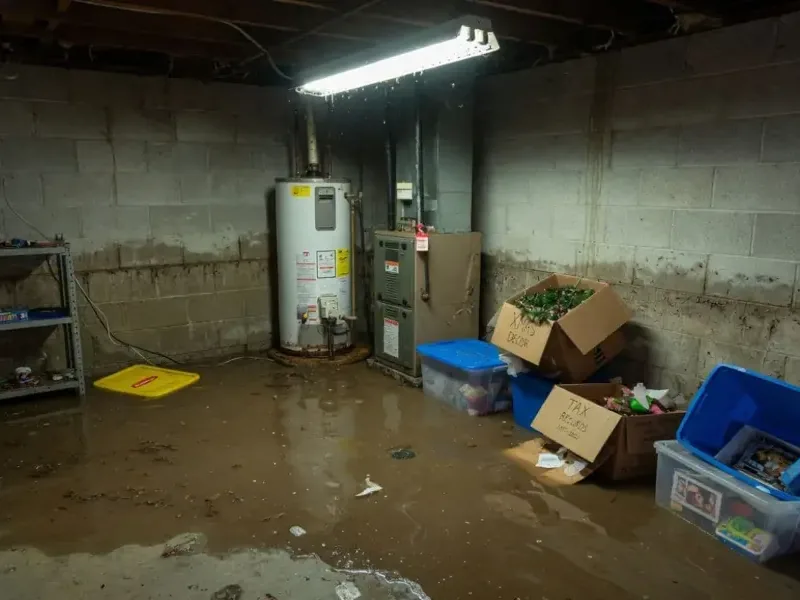
A tank water heater fails in a few ways: the steel tank rusts through and splits, the drain valve or a fitting leaks, or the temperature and pressure relief valve opens and keeps discharging. Because the cold supply keeps refilling the tank, a failure can keep going until someone closes the valve.
Where the water ends up in Lafayette homes
A water heater usually sits in a basement mechanical room, a utility closet or the garage. In a finished basement near Indian Peaks or Lafayette Park, water spreads under the wall into carpet and the bottom of the drywall in the next room. In a garage, it runs across the slab and into stored boxes. In the 1950s homes off South Public Road, a heater in a closet off the kitchen can soak the subfloor and cabinets.
- Basement mechanical rooms next to finished space
- Utility closets on main floors
- Garages with stored boxes on the slab
- Laundry rooms that share a wall with living space
Shutting it down
Close the cold water supply valve on top of the heater. For a gas heater, turn the control to off or pilot; for an electric heater, switch off its breaker. If the supply valve will not close, close the main. The tank stays full of hot water, so keep clear of the drain valve and let a plumber handle the replacement.
- Cold supply valve closed at the top of the tank
- Gas set to off or pilot, or the breaker off
- Keep clear of the hot drain valve and fittings
Drying after a tank failure
Clean water caught early is Category 1 and often dries in place. If it sat for a day or two, or ran through stored items, the pad and drywall usually come out. The Department of Energy Energy Saver pages cover water heater care and replacement choices, and the Consumer Product Safety Commission posts recalls and safety notices for home appliances.